
Between November 2026 and August 2027, Kenya’s political parties must settle their rules, sign their coalitions and choose their candidates before the country votes on Tuesday, 10 August 2027.
This guide sets out every deadline on the Kenya 2027 election timeline, explains what each one means, and shows you where to verify it.
Six Dates That Shape The Kenya 2027 Election Timeline
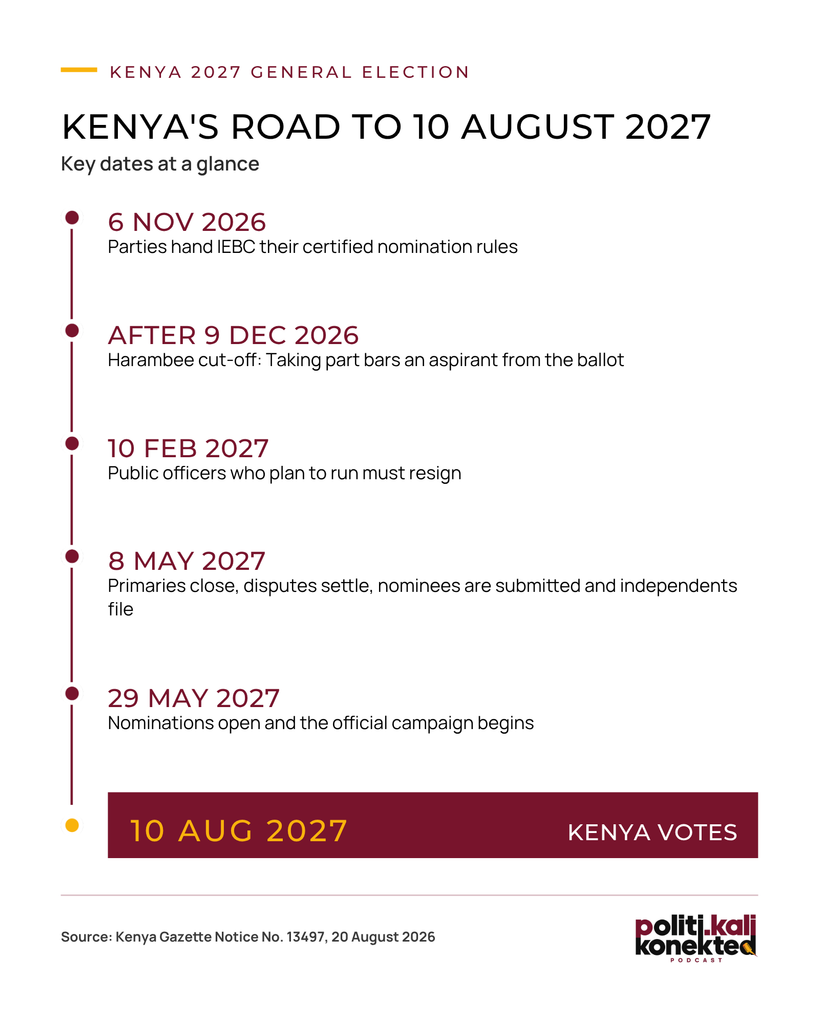
Look closely and the calendar splits in two. Everything up to 8 May 2027 belongs to the parties and the people competing for their tickets. From 29 May, however, the contest moves into IEBC’s hands and onto the campaign trail.
In other words, the first half decides who runs, and the second half decides how they run.
Who Enforces The Rules?
Did you know two separate institutions oversee Kenya’s election calendar?
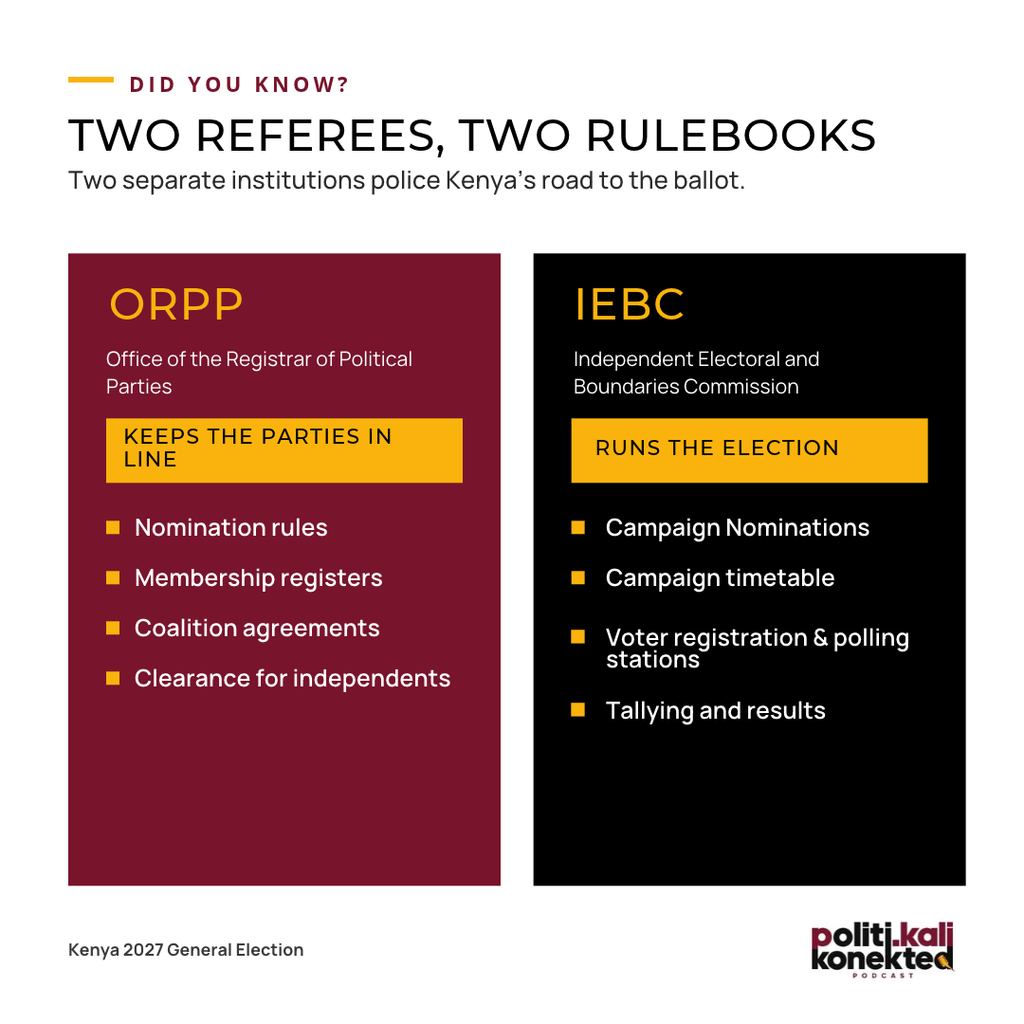
The split matters most when something goes wrong. For example, a complaint about how a party ran its primaries or kept its membership register starts inside the party, through its internal dispute mechanisms. From there, it can go to the Political Parties Disputes Tribunal.
A complaint about a nomination lodged with IEBC, on the other hand, goes to the commission itself. Knowing which referee to approach saves aspirants precious time.
ORPP: Getting The Parties In Order
Before a single candidate is chosen, every party must prove it plays by the rules. ORPP’s Salient Processes and Timelines for the 10 August 2027 General Election, drawn from the Political Parties Act and the Elections Act, set out what each party owes the Registrar.
| Date / Period | ORPP Requirement |
| 28 September to 16 October 2026 | Political parties submit their election and nomination rules. |
| 7 to 15 October 2026 | Parties submit the names and specimen signatures of authorised officials to ORPP and IEBC. |
| 30 October 2026 | Deadline for ORPP to certify party nomination rules. |
| 6 November 2026 | Parties submit certified nomination rules to IEBC. |
| By 23 March 2027 | Party membership registers are due for certification by the Registrar. |
| 12 April 2027 | Deadline for submitting agreements to form a coalition political party. |
| 8 May 2027 | Deadline for party members intending to run as independents to resign from their parties. |
| 9 May 2027 | Deadline for submitting pre-election coalition agreements for confirmation. |
The first cluster of deadlines, running from late September to 6 November 2026, lays the foundation for everything that follows. Nomination rules are the playbook for every primary. As a result, a party whose rules fail certification starts the race on the back foot.
The 12 April 2027 cut-off for coalition political parties is where months of alliance talk must become signed agreements. Which of the partnerships announced along the way will make it onto paper?
IEBC: The Legally Binding Timetable
Once parties are in order, IEBC takes over. Its dates come from Gazette Notice No. 13497 and the related notices of 20 August 2026, and they carry the force of law.
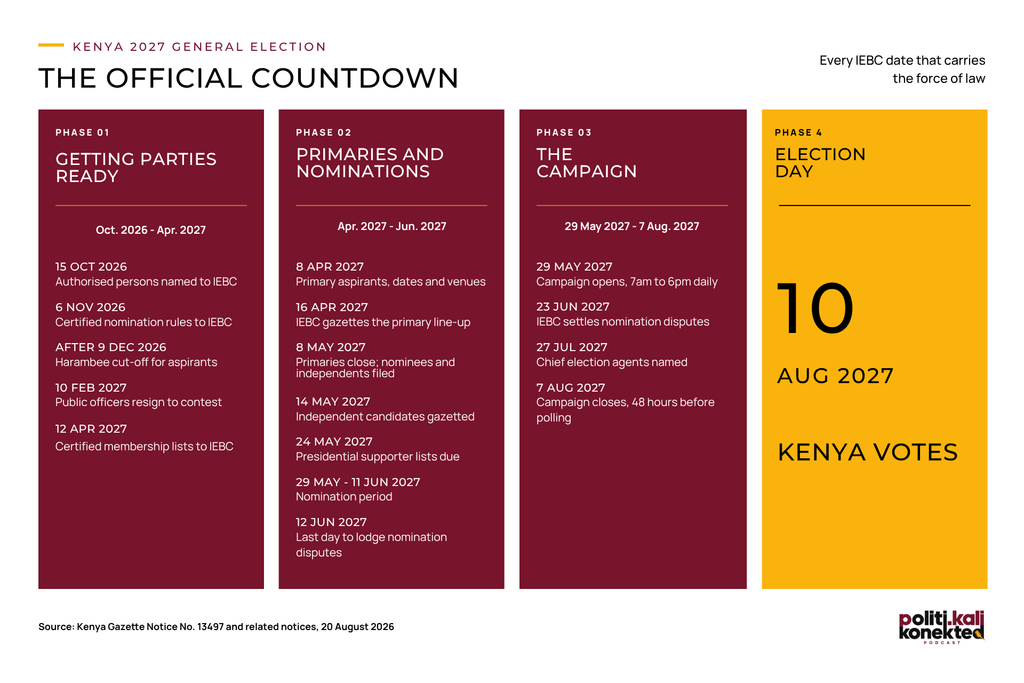
The Office of the Registrar of Political Parties (ORPP) keeps parties in line: their nomination rules, membership registers and coalition deals. The Independent Electoral and Boundaries Commission (IEBC) runs the election itself, from candidate nominations to the polling station and the final tally.
IEBC gave formal notice of the 2027 General Election in the Kenya Gazette on 20 August 2026, setting binding dates for every party and aspirant. Its Election Operation Plan 2025-2027 maps the logistics behind those dates, while ORPP has published its own compliance calendar for parties and would-be independents.
The Fine Print
A few details sit behind the dates in the countdown:
· Indirect Participation Counts: The harambee rule covers taking part in a public fundraiser directly or indirectly.
· Presidential Supporter Lists: By 24 May 2027, presidential aspirants must submit the names of at least 2,000 registered voters in each of a majority of Kenya’s counties.
· Nomination Windows Vary: The nomination window differs by elective seat, from 29 May to 11 June 2027, and only the presidential window runs the full period.
· Campaign Hours: Campaigning is allowed from 7am to 6pm daily and closes 48 hours before polling.
· Nomination Disputes: These must be lodged by 12 June 2027, and IEBC must decide them by 23 June 2027.
Why These Dates Matter
The Harambee Cut-Off. Public fundraising has long been one of the most visible ways Kenyan politicians court voters. After 9 December 2026, however, taking part in one, directly or indirectly, disqualifies an aspirant. Expect a flurry of fundraisers before the cut-off and some careful choreography after it.
The February Exits. The 10 February 2027 resignation deadline is the first hard test of ambition. It will show who is serious about running, and it may also bring a wave of high-profile departures from government.
Less Time To Pick Flag Bearers
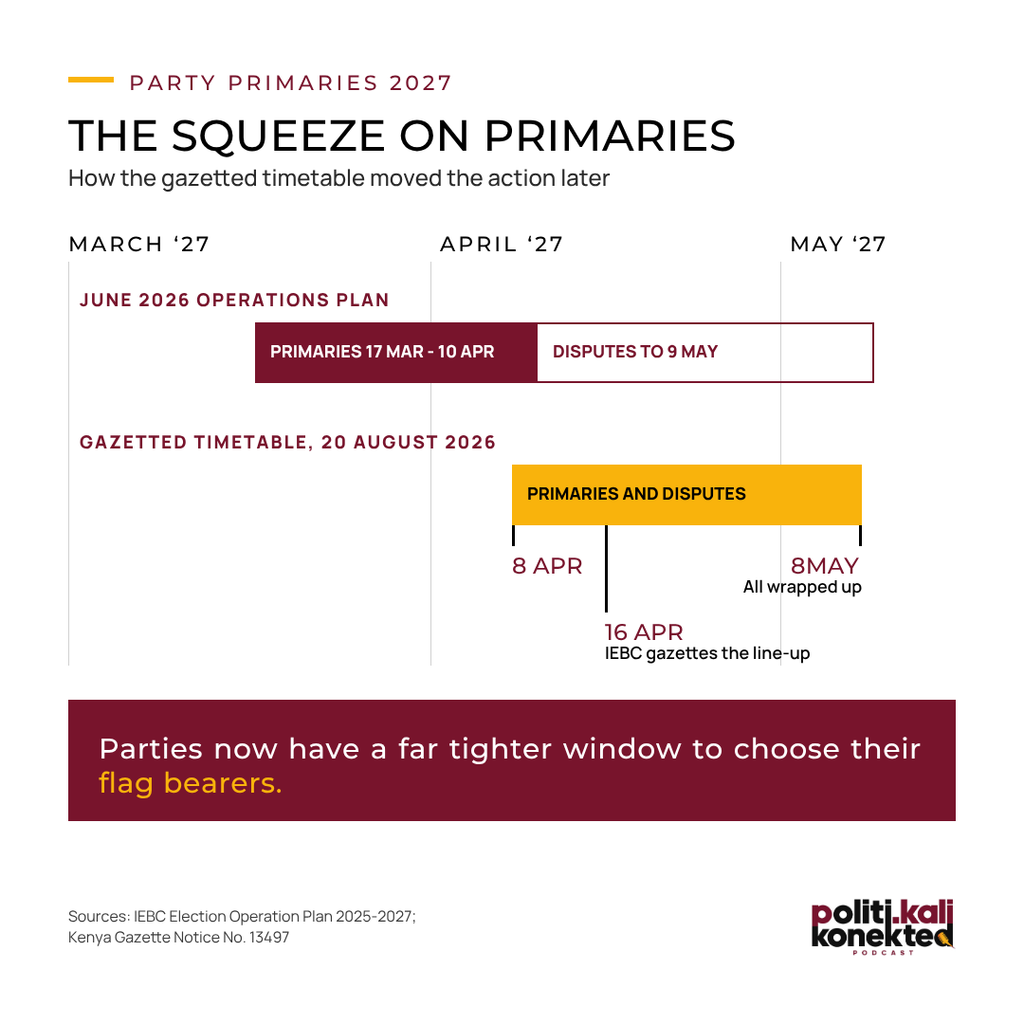
Behind those dates sits a logistical crunch. Under the gazetted timetable, vetting aspirants, running primaries and hearing appeals share roughly a month. Consequently, every internal dispute that drags on eats into the time left to submit nominees, and party dispute committees will be working against the clock.
Why 8 May 2027 Is The Pressure Point
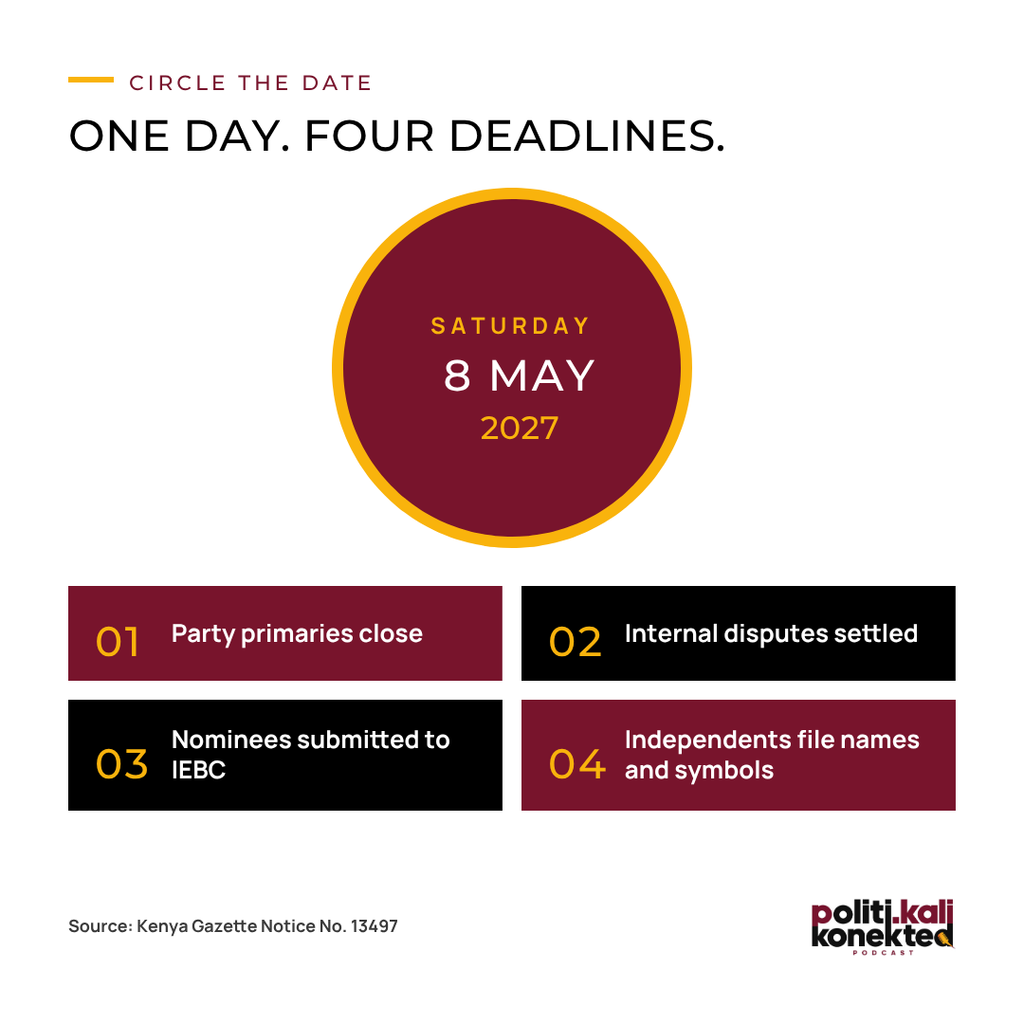
The overlap carries a sting. An aspirant who loses a primary close to the cut-off has little or no room left to resign and file as an independent. In short, the old route of losing a primary on Friday and declaring an independent bid on Monday is effectively closed.
Meanwhile, the pressure continues into the next day. Pre-election coalition agreements are due at ORPP on 9 May 2027, so coalition partners must finalise their deals just as their nominee lists land at IEBC.
IEBC’s Operational Plan Behind The Kenya 2027 Election Timeline
Laws set the deadlines; logistics deliver the vote. The Election Operation Plan 2025-2027 schedules the staffing, technology and polling-station work running alongside the political calendar.
| Date / Period | Planned IEBC Activity |
| 29 March to 26 June 2027 | Recruitment of temporary election officials. |
| 28 to 29 April 2027 | Appointment and gazettement of Returning Officers. |
| 5 to 9 June 2027 | Testing and verification of election technology. |
| 4 to 8 July 2027 | Gazettement of polling stations. |
| 1 to 3 August 2027 | Display of the voter register at polling stations. |
These operational dates may shift as IEBC issues further notices. Where the plan and the gazetted timetable differ, the Gazette prevails.
The technology test in June is the one to watch. After the scrutiny of past elections, how IEBC’s systems perform under pressure will shape public confidence long before a single ballot is cast.
Practical Pointers For Every Player
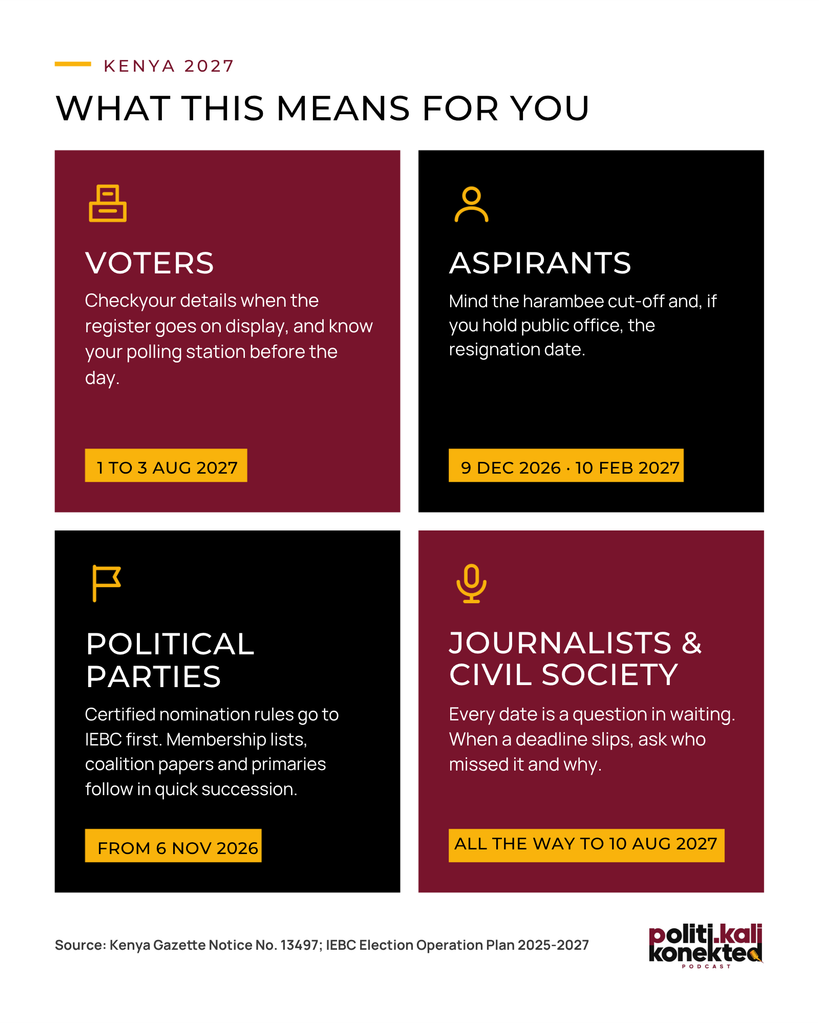
Beyond the dates in the graphic, a few habits will help:
· Voters: The register display runs for just three days and ends a week before polling. Confirm your name, ID details and polling station in that window, and plan your visit early.
· Aspirants: Keep a copy of your party’s certified nomination rules. If you challenge a primary result, the dispute will be judged against those rules.
· Political Parties: Publish your primary schedule and dispute procedures early. Aspirants who know the rules in advance are less likely to contest results, which protects the narrow window before nominations close.
· Journalists and Civil Society: Compare the operational plan with the gazetted timetable as the year unfolds. Where the two drift apart, there is usually a story.
Where Can You Verify The Kenya 2027 Election Timeline?
a. Office of the Registrar of Political Parties (ORPP)
b. Independent Electoral and Boundaries Commission (IEBC)
· Election Operation Plan 2025-2027
c. Kenya Gazette
· The official publication for formal legal notices, including the election date and statutory deadlines.
· IEBC published Gazette Notice Nos. 13497 to 13503 on 20 August 2026 (Vol. CXXVIII, No. 144), followed by Notice No. 13771 on 26 August 2026.
· For formal verification, read the relevant Gazette entries alongside the commission’s official notices.
Kenya 2027 Election Timeline: Frequently Asked Questions
When is Kenya’s next General Election?
Tuesday, 10 August 2027, as gazetted by IEBC on 20 August 2026.
What is the difference between ORPP and IEBC?
ORPP regulates political parties, including their nomination rules, membership registers and coalition agreements. IEBC conducts the election, from candidate nominations to polling and results.
When must party primaries be completed?
By Saturday, 8 May 2027, including the resolution of any internal party disputes.
When must public officers resign to run in 2027?
On or before Wednesday, 10 February 2027.
What is the harambee ban?
Anyone who takes part in a public fundraiser or harambee after 9 December 2026, directly or indirectly, is disqualified from contesting in the 2027 General Election.
When does the campaign period start and end?
It runs from Saturday, 29 May 2027 to Saturday, 7 August 2027, between 7 am and 6 pm each day.